How much does a penetration test cost in Pakistan? It is the first question every buyer has and the one the industry answers worst. Most vendors will not publish anything. The ones that do publish a single number that means nothing without a scope attached. So the buyer ends up where we described in how to choose a penetration testing company: four quotes on the desk, from PKR 120,000 to USD 9,000, all apparently for the same job.
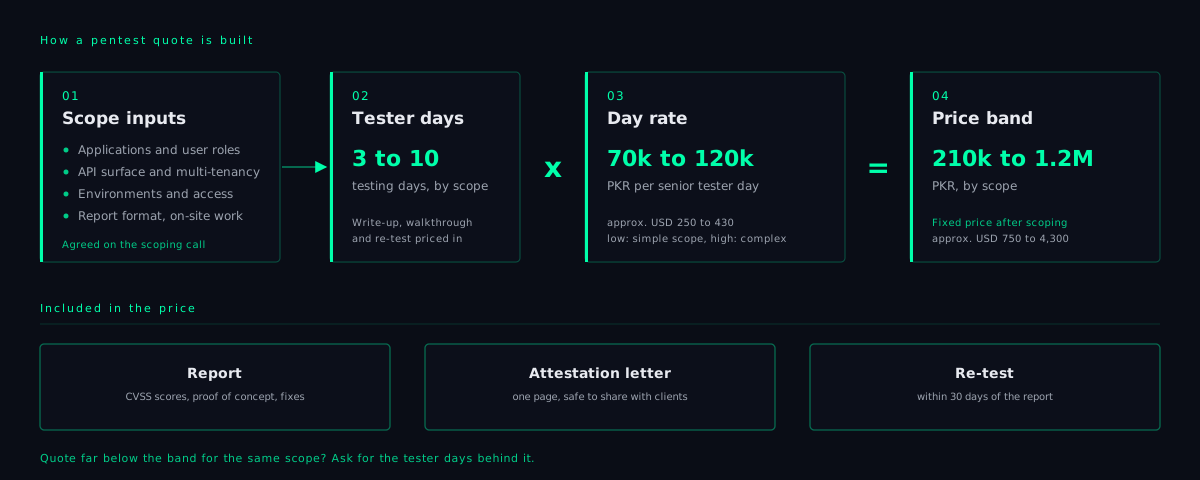
This post publishes our typical ranges. It is not a price list, because a quote still comes after a scoping call. But the ranges are derived from the way we actually price, which is tester days multiplied by a day rate, and once you know your own scope you can estimate within about twenty percent before you email anyone. That is enough to budget, to sanity-check a quote you already have, and to spot the one that is really a scan.
Two audiences will read this. Pakistani software houses and SaaS companies whose client has asked for a pentest and who need a number for the finance conversation. And overseas buyers vetting a Pakistani vendor, wondering why the local quote is a third of the one from home. Both get the same arithmetic. Prices are in Pakistani rupees with approximate US dollar equivalents at roughly PKR 280 to the dollar. The rate moves, so treat the dollar figures as a guide.
The Short Answer: Typical Price Bands in Pakistan
The table below is what a manual-first engagement typically costs in Pakistan for the scopes we are asked to test most often. Every row assumes the same thing: a senior tester working by hand against your application with credentials for each role, a report written for your engineers and for your client's reviewer, a letter of attestation, and one re-test after you fix what was found. The day counts are testing days. The write-up, the walkthrough call and the re-test are priced into the band rather than billed on top.
| Scope | Testing days | Typical price (PKR) | Approx. USD |
|---|---|---|---|
| Focused test of a small app or a single release | 3 to 5 | 210,000 to 600,000 | 750 to 2,150 |
| Web application: SaaS or portal with several roles | 5 to 10 | 350,000 to 1,200,000 | 1,250 to 4,300 |
| API: REST or GraphQL, mid-sized | 4 to 7 | 280,000 to 840,000 | 1,000 to 3,000 |
| Mobile app with its backend | 5 to 8 | 350,000 to 960,000 | 1,250 to 3,450 |
| Cloud configuration review: AWS, Azure or GCP | 5 to 10 | 350,000 to 1,200,000 | 1,250 to 4,300 |
| Internal network | 3 to 7 | 210,000 to 840,000 | 750 to 3,000 |
| External attack surface and subdomain check | 1 to 3 | 70,000 to 360,000 | 250 to 1,300 |
Typical ranges for a manual-first engagement. USD at roughly PKR 280 to the dollar. Final price fixed after scoping.
Where your product lands inside a band depends on the drivers covered in the next two sections. A two-role SaaS with a small REST API sits in the lower half of the web application row. A multi-tenant platform with six roles, a GraphQL API and a separate admin portal sits at the top of that row, or more honestly in the web row plus the API row, because at that point the API is a second application.
Anything far below these ranges for the same scope is not a cheaper pentest. It is a different product, usually an automated scan with a cover page, and the section on why quotes vary so widely explains how to tell.
How a Quote Is Built: Tester Days Times a Day Rate
There is only one honest unit for pricing manual security testing, and it is the tester day. Everything a vendor tells you about packages or starting-from prices is a wrapper around the number of days they expect one person to spend, multiplied by what that person's day costs. Ask for the days and the arithmetic falls out.
Our day rate lands between PKR 70,000 and PKR 120,000, roughly USD 250 to 430. The low end applies to a simple, well-documented scope where nearly every day is testing. The high end applies to complex scopes that need senior time throughout: multi-tenant authorisation matrices, chained exploitation that takes patience to prove, and reporting that has to satisfy a SOC 2 auditor or a bank's third-party risk team rather than just your developers.
A worked example. Take a multi-tenant SaaS with four user roles, a REST API used by the front end, a staging environment that mirrors production, and a client who wants a report they can hand to their auditor. That is about eight testing days: two on recon and mapping, three on authentication and the authorisation matrix across four roles and tenant boundaries, two on business logic and the API, and one on confirming findings against production in an agreed window. Eight days at the upper-middle of the rate is PKR 800,000 to 950,000, roughly USD 2,850 to 3,400, with the report, attestation letter and re-test inside that figure.
What a day actually buys is easy to underestimate. Our day-by-day breakdown of a five-day web pentest shows how a full day of recon turns into the two findings on day four that matter. When a vendor quotes two days for a product like the one above, they are not being efficient. They are skipping the authorisation testing, which is where the findings that end contracts live.
What Moves the Number Up or Down
The full list of cost drivers is in our complete guide to penetration testing in Pakistan, and the questions we use to measure them are in the scoping call. This section only covers how much each one moves the days.
- User roles. Each additional role adds roughly half a day to a full day, because authorisation is tested for every role against every other. Four roles is not twice the work of two; it is closer to three times.
- Multi-tenancy. Tenant isolation is its own test, typically a day, and it is the test your enterprise clients care about most.
- API surface. An API used only by your own front end adds a day or two to a web engagement. A public or partner API with its own authentication and documentation is a separate row in the table.
- Environments. Testing staging and then confirming against production in a maintenance window adds about a day. Testing production only, out of hours, adds more, because the tester works slower to stay safe.
- Black box versus grey box. Withholding credentials and documentation costs one to two days of discovery that finds nothing you did not already know. Grey box is cheaper and finds more.
- Reporting format. Our standard report satisfies SOC 2, ISO 27001 and most client questionnaires. Mapping findings clause by clause into a client's own template adds a day or two of writing.
- On-site work. Internal network tests can run remotely through a small jumpbox. If your policy requires the tester on site in Karachi, Lahore or Islamabad, travel is added at cost.
Some things do not move the price, and it is worth knowing which. The size of your company does not: a ten-person startup with a complex product pays more than a two-hundred-person firm with a simple one. The number of findings does not: you pay for the days, not per bug. Urgency changes the start date more than the price. And the fact that your client demanded the test does not change the price either, though a report they will accept is the whole point, which is why reporting depth is on the list above.
Why PKR 120,000 and USD 9,000 Can Both Be Called a Pentest
Put the two extremes from the choose-a-company post through the arithmetic above and both make sense, just not as the same product.
PKR 120,000 is one to two days at any credible day rate. One to two days is enough to run a scanner, export the results and put a logo on the cover. It is not enough to test authorisation across roles or to prove a single chained exploit. That does not make the quote dishonest, but it makes it a vulnerability scan, and it will not survive the review your client's security team gives it. The tell is that the vendor cannot show you the tester days, or the sample report reads like a tool export. Both checks are in how to choose a penetration testing company in Pakistan, and the difference between the two products is spelled out in penetration testing vs vulnerability assessment.
USD 9,000 is usually a firm in the United States, the United Kingdom or the Gulf quoting the same eight to ten days at their own day rate. Their costs are several times ours, so the price is several times ours. The work is not several times deeper. Penetration testing is a global skill with global scoreboards, and a tester's bug bounty ranking or CVE list reads the same from Lahore as it does from London. What an overseas buyer pays for at the top of the range is mostly the vendor's overheads and the comfort of a local invoice. And if a developer suggests a bug bounty instead of either, read pentest vs bug bounty first; on an untested product it is not the cheaper option.
The bands in the table sit between those extremes because that is what five to ten days of a senior tester's time costs in Pakistan. When a quote lands outside them, ask which of the two products you are being sold.
What the Price Includes at VAPT.PK, and What Costs Extra
The number we quote is for a fixed scope, and it includes everything needed to close the engagement.
- A 30-minute scoping call, followed by a written scope, rules of engagement and an authorisation letter for you to sign.
- Manual testing by a named tester against OWASP and PTES, with critical findings reported the day they are confirmed rather than held for the report.
- A report with an executive summary and each finding scored with CVSS, backed by proof-of-concept evidence and a remediation step your engineers can act on.
- A walkthrough call with your engineers after delivery.
- A one-page letter of attestation you can send to clients without exposing the technical detail.
- One re-test of every finding within 30 days of the report, with the report reissued showing closed status. That reissued version is the one you send to clients.
Some things are quoted separately, and we say so before they happen rather than after.
- Scope added mid-engagement, such as an admin portal nobody mentioned on the call, is quoted per additional day before it is tested.
- A second re-test after the 30-day window, or a re-test after a major release, is a short new engagement.
- Reports mapped into a client's own questionnaire or template: a day or two of writing.
- Travel for on-site work.
- Quarterly or continuous testing runs on a standing arrangement. It works out cheaper per engagement than one-off tests, because the tester already knows the product, but it is priced per period rather than from the table.
Paying in PKR or USD
Pakistani companies are usually invoiced in rupees and pay by local bank transfer. Overseas clients are invoiced in dollars. Because the exchange rate moves, the quote is fixed in one currency when you sign the scope rather than converted on the day the invoice is raised, so the number you approved is the number you pay.
A question that comes up often: when a client demands the test, who pays? You do, almost always. It is your product, the findings are yours to fix, and the report and attestation letter are yours to reuse with the next client who asks. Some enterprise buyers will fund a test they insist on, particularly if they want to set the scope, and it is worth asking. Either way, make sure the engagement is contracted with you, so that you own the report.
Whatever vendor you choose, tie the final payment to delivery of the report rather than to the start of testing, and confirm in writing that the re-test is inside the price rather than a separate invoice. Those two clauses remove most of the disputes we hear about from companies that bought elsewhere first.
How to Lower the Cost Without Lowering the Quality
You cannot make manual testing cheaper by asking for fewer days on the same scope. That just removes the manual part. You can make the days count for more, and every item here is something we would ask you to do anyway.
- Scope the product, not the company. Test the application your clients log into and the API behind it. Leave the marketing site, which holds nothing, to a scanner.
- Choose grey box. Provide working credentials for every role, API documentation and a short architecture note. Black box spends your first day or two on discovery that your own documentation would have answered.
- Have staging ready on day one. It should mirror production, hold realistic test data, and have the tester's address allowlisted on the WAF. A tester who spends day one chasing access has lost a fifth of the engagement.
- Name one contact who can answer questions within the hour. Most delays in a pentest are waiting for a reply about whether a behaviour is intended.
- Bundle surfaces that share recon. A web application and its API tested together cost less than the two rows in the table added up, because the mapping work is done once.
- Fix quickly and re-test inside the window. A re-test after the window is a new engagement, and a report that still shows open criticals does not help you with the client who asked for it.
- Test annually on a standing arrangement rather than starting from scratch each year. The second test on a product the tester already knows is faster, and the price reflects it.
What not to do is squeeze the report. The report is the deliverable your client actually reads, and the cheapest way to fail a vendor review is a thorough test written up as a tool export.
Frequently Asked Questions
Is the cheapest quote always a scan?
Not always, but below roughly PKR 200,000 for a real SaaS product it is worth asking. Divide the quote by a credible day rate and you get the tester days. If the answer is one or two, ask the vendor how they intend to test authorisation across your roles in that time. A vendor doing genuine manual work will be glad to show the days behind the number.
What should we budget for security testing per year?
For most product companies: one full test of the main application per year from the web application row, plus the API or mobile row if those are separate surfaces, with the re-test inside the price. Add automated scanning monthly between tests. It costs a fraction of a pentest and catches the newly published vulnerability in a library you shipped months ago. If a large client is onboarding, budget the test before the contract, because they will ask.
Does the re-test cost extra?
Not with us, within 30 days of the report. Elsewhere, sometimes, and it is the most common way a low quote grows. Ask the question before you sign, and get the answer into the scope document.
Do bigger firms charge more for the same work?
Usually, and the difference is overhead rather than depth. What decides the quality of a pentest is the named person doing it, not the size of the company invoicing you. Ask who is testing, look them up, and compare the tester days in each quote rather than the logos.
Can we get a fixed price?
Yes. After the scoping call the quote is a fixed price for a fixed scope, and it stays fixed unless the scope changes. If you add an application or a role mid-engagement, the additional days are quoted before they are worked, not discovered on the invoice.
Penetration testing in Pakistan costs what a senior tester's days cost, and the ranges above are that arithmetic written down. If a quote fits inside them, the questions left are about the tester and the report. If it sits far outside them, you are probably looking at a different product, whichever direction it falls. Get the tester days in writing and the rest follows.
Want a number for your actual product rather than a range? Tell us what you have built, we will ask the seventeen questions, and you will have a fixed quote within 24 hours of the call.