Every few months a founder asks us the same question, usually the week after a client has asked for a pentest and a developer has suggested a bug bounty instead, because that is what the big companies do. Both are real security testing. Both involve people who break software for a living. They are not substitutes, and doing them in the wrong order wastes money in a way that is hard to see until the invoices arrive.
We are in an unusual position to answer. Hassan has reported more than a thousand vulnerabilities across more than a hundred bug bounty programs, with active rankings on Bugcrowd, YesWeHack and HackenProof, and spends the rest of his time running penetration tests for Pakistani software houses. This post is the view from both chairs: what each one is good at, what each one quietly misses, what each one really costs, and the sequence we would recommend to a SaaS company that can only afford one of them this quarter.
The Short Answer
Pentest first. Fix what it finds, re-test, and then, once you have someone to triage reports and a budget to pay for them, open a private bug bounty. Go public only when the private program has gone quiet. A bug bounty on an application that has never been tested is not a bargain. It is an invitation to pay retail, one finding at a time, for the bugs a pentest would have delivered in a fixed-price report with a letter you can show your auditor.
The rest of this post is why, and what to have in place before you open the doors.
What Each One Actually Is
A penetration test is a bounded engagement. One named tester or a small team, an agreed scope, credentials for every user role, a fixed number of days, a report, and a re-test after you fix things. You pay for the time, not for the findings. The output is designed to be read by your engineers and accepted by a third party, which is why it ends with a letter of attestation. How an engagement runs, step by step, is in our complete guide to penetration testing in Pakistan.
A bug bounty is an open invitation. You publish a scope and a payout table, hunters anywhere in the world test whatever they can reach with the access you have given them, and you pay per valid, unique finding, usually through a platform such as Bugcrowd, HackerOne, YesWeHack or Intigriti that charges a fee on top. Nobody is obliged to test anything. Hunters go where the payouts are fair, the triage is fast and the targets are interesting, and they leave the moment any of those stops being true.
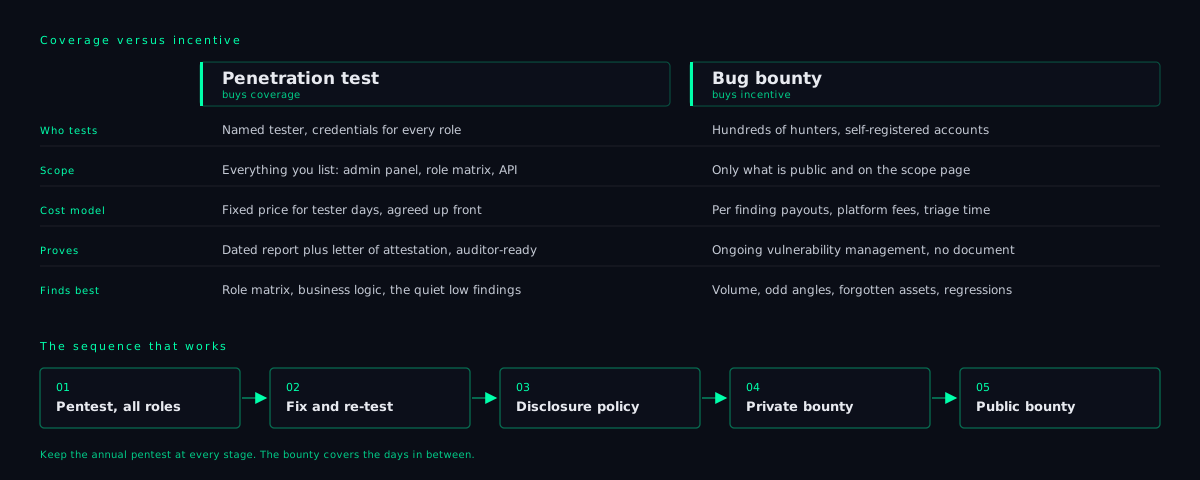
The difference that matters is this: a pentest buys coverage, a bounty buys incentive. Coverage is systematic and finite. Incentive is open-ended and uneven. Everything else in the comparison follows from that one line.
What a Bug Bounty Finds That a Pentest Does Not
A good bounty program is genuinely powerful, and we say that as people who have earned from them for years. Four things it does better than any single tester can.
- Volume and odd angles. Hundreds of people with different habits and different tooling will try the thing one tester did not think of. Our MFA bypass writeups came from exactly that: ten programs, ten different ways the same control failed, found by looking where the program owners had not.
- Continuous coverage. A pentest is a snapshot of a week. A bounty is running the morning after your Friday deploy, which is when the regression ships.
- Forgotten assets. Hunters are relentless about subdomains, old hosts and abandoned integrations, because that is where the easy money is. The subdomain takeover we wrote up was on an asset its owner had forgotten existed.
- Rare specialisms. Somewhere in the crowd is a person who only does race conditions, or only OAuth, and they will find the one bug in that class that a generalist walks past.
Now the other half, which the platform marketing does not mention. A bounty structurally misses several things.
- Authorisation across roles. Hunters test with accounts they can self-register. The matrix of admin against tenant, manager against employee, support against customer needs credentials you will never hand to strangers, and that matrix is where most of the critical findings in our pentests live.
- Anything behind an invitation, a paywall or a sales call. If a hunter cannot reach it for free, it is not tested.
- Scope you did not publish. Internal tools, staging, the admin panel on a different hostname, the API that only the mobile app calls. Hunters test what the scope page lists.
- Low and medium findings. A security header or a verbose error pays nothing, so it sits in a hunter's notes until it can be chained into something that does pay. You find out about it later, as part of a critical.
- The document. A bounty produces tickets. It does not produce a report, a methodology statement or anything an auditor will accept as evidence.
What a Pentest Finds That a Bounty Does Not
Start with the quiet bugs. A pentester is paid for the day, so there is no reason to skip a finding because its payout would be small. The informational and low findings that get written up in a pentest report are the ones that chain into a critical six months later, and nobody in a bounty reports a missing header or an overly chatty API response, because it is not worth the form.
Then the full role matrix. A grey-box pentest with credentials for every role, architecture notes and API documentation spends its days on tenant isolation, privilege escalation and business logic, the parts of a SaaS that decide whether an enterprise client signs. That is the testing a bounty cannot do, and it is the reason we push buyers towards grey box in penetration testing cost in Pakistan: the credentials you provide are what make the days count.
Then the things an auditor accepts. Dates, a named tester, a stated methodology, a re-test, a signed letter. SOC 2 and ISO 27001 auditors and your client's vendor-risk team want independent, point-in-time evidence that a defined scope was tested and fixed. A bounty program is evidence of something else, ongoing vulnerability management, which is a different control, and it does not come with a letter.
Finally, a clean negative. A pentest can say, in writing, that the login, the role matrix and the API were tested for eight days and nothing above medium remained after re-test. A bounty that has gone quiet might mean the application is solid, or might mean nobody is looking any more. You cannot tell which from the inside, and neither can your client.
What Each One Costs
A pentest is a fixed number agreed before work starts. Our typical bands by scope are in the cost post: a SaaS web application lands between PKR 350,000 and 1,200,000 for five to ten testing days, with the report, the attestation letter and one re-test inside that figure. You know the cost before you commit and it does not change with the number of findings.
A bounty has three costs, and only one of them arrives as an invoice.
- Payouts. Programs that attract experienced hunters pay in the hundreds of dollars for a medium finding and in the low thousands for a critical. Pay noticeably less and the experienced hunters do not show up; the ones who do are running scanners, and you will be triaging their output by the hundred.
- Platform fees. The managed platforms charge for the program itself and take a share of each payout. Running it yourself saves the fee and costs you the triage tooling, the payment rails and the hunters who only work through platforms.
- Triage. Someone on your team has to read every report within days, reproduce it, decide whether it is valid and how severe it is, argue about duplicates, and pay promptly. That is a part-time job from the first week and a full-time one in the first month after a public launch.
The rule that follows: a bounty you cannot afford to triage is worse than no bounty. Reports sit, hunters leave, and the ones who stay are the ones who will go public when they are ignored. For a first year, the honest comparison is that a pentest costs what it costs, while a bounty on an untested application costs roughly the pentest's price again in payouts for the same findings, plus the fees, plus the staff time, and still leaves the role matrix untested.
What the Hunter Sees When a Pakistani SaaS Launches a Program
From the other side of the table, a new program is a pattern we have watched many times. The first week is a flood of duplicates: twenty reports of the same missing rate limit on the password reset, because every scanner in the world found it on day one. Then the scope confusion: hunters hit the marketing site, the staging server and the old mobile API, because the scope page said "*.yourdomain.com" and nobody thought about what that included. Then the payout disputes, usually about severity, usually with the first hunter who found something real.
What happens next decides the program. If the first response takes weeks, if real bugs are marked informational to avoid paying, or if payment waits for the fix rather than the triage, the program gets a reputation within a month. The platforms publish response times and acceptance rates, experienced hunters filter on them, and what is left is beginners with scanners. At that point you are paying bounty rates for the same tool output a cheap pentest would have sold you, now arriving by the hundred.
What keeps good hunters on a program is simple and entirely within your control: a first response in days, severity decided by a published rubric rather than by mood, payment on triage, a scope page that says what is in and what is out, and a safe harbour statement that says you will not pursue people who test in good faith. Those five things cost nothing and they are the whole difference between a program that works and one that becomes a support queue.
The Sequence That Works
- Pentest the product with credentials for every role. Fix the criticals and highs. Re-test, and get the letter of attestation re-issued to reflect the fixes. This is the step your clients will ask about.
- Publish a vulnerability disclosure policy: a security.txt file, a security address that a human reads, and a safe harbour statement. It costs nothing and gives the well-meaning reports you are already receiving somewhere to go.
- Open a private bounty. Invite a small group of hunters, through a platform or directly, with a limited scope and a fixed window of a few weeks. Learn triage at a volume you can handle, and set your payout table against what actually arrives.
- Go public only when the private program has gone quiet, you have a named owner for triage, and there is a payout budget for the year that finance has agreed to.
- Keep the annual pentest. The bounty covers the days between tests; it does not replace the role matrix, and it does not produce the document your next enterprise client will ask for.
Before day one of any program, have the following written down: who triages and how fast, how much you can pay this year, what is in scope and what is explicitly out, which severity rubric you use (CVSS is fine, as long as you apply it the same way every time), and the safe harbour wording. If you cannot fill in all five, you are not ready, and that is not a criticism. Most companies are not, and a pentest is the right purchase until they are.
Frequently Asked Questions
Does a bug bounty satisfy SOC 2 or a client security questionnaire?
No. Auditors and procurement teams ask for an independent, dated penetration test with a named tester, a defined scope and a letter of attestation. A bounty is good evidence for a different control, ongoing vulnerability management, and it is worth mentioning in the questionnaire, but it does not answer the pentest question. Our US client post walks through what their security team actually checks.
Can we run both?
Yes, and mature product companies do. The pentest covers what the bounty structurally cannot reach, and the bounty covers the days between pentests. Just run them in that order the first time.
Is a vulnerability disclosure policy the same as a bounty?
No. A disclosure policy says how to tell you about a bug and promises you will not pursue people who report in good faith. It promises no payment. Every company with a public application should have one today. A bounty adds money, a scope page and usually a platform on top.
What if we cannot afford either right now?
Fix the free things first. Our walkthrough of the OWASP Top 10 in Pakistani SaaS products covers what each flaw looks like and what to fix first. Publish a disclosure policy. Then buy a focused pentest of the login and the role matrix, the three to five day row in the cost table, before the client who asks for a report arrives. That one is a matter of when, not if.
A pentest and a bug bounty answer different questions. The pentest answers "is this product safe to sell, and can we prove it". The bounty answers "is anyone finding anything we missed, continuously". Buy the first answer before you pay for the second, and when you are ready for the second, treat the hunters the way you would want to be treated. We have been on their side of the table for a long time.
Not sure which row of the cost table your product sits in? Tell us what you have built and we will tell you what belongs in scope.